36 projects found
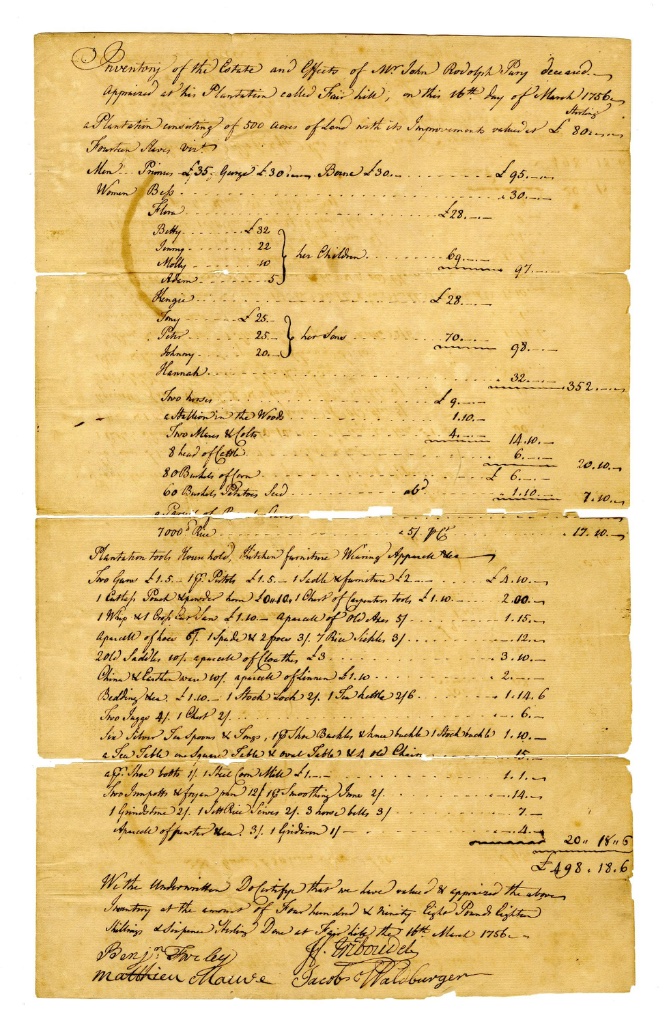
1756 Inventory of Estate of Mr. John Rodolph Perry — Plantation Slaves, Fair Hill
Two-page document: cover sheet labeled 'A No. 9 — Inventory & Appraisement of the Estate of Mr. John Rodolph Perry deceased, recorded in Book F folio 23.' Main document is a detailed inventory of the estate and effects of Mr. John Rodolph Perry, appraised at his plantation called Fair Hill on the 16th day of March 1756. Lists enslaved people by name with valuations: Men — Primus £35, George £30, Bene £30; Women — Bess £30, Flora £28, Betty £32, Jenny £22, Nelly £10, Adam £5 (her children £69), Hengee £28, Tony £28, John £28, Johnny £20 (her sons £70=£98), Hannah £32. Also lists plantation stock, tools, household furniture, weaving apparatus. Total £498.18.6. Signed by Benj. Hurley, J.H. Boulden, Matthieu Hause, Jacob Waltburger.
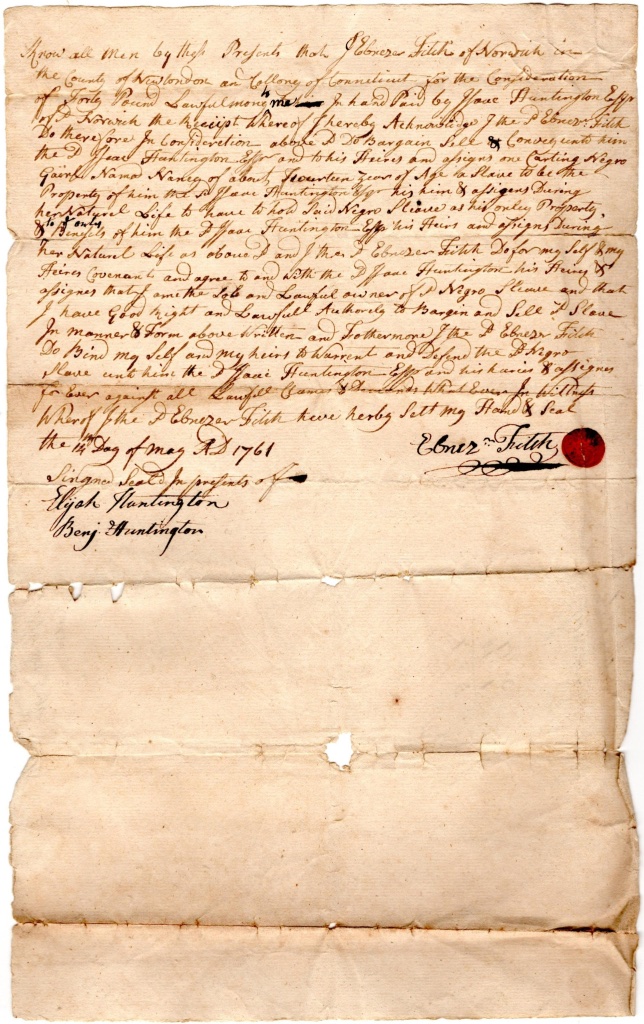
1761 Connecticut Bill of Sale — Nancy, Enslaved Girl, Norwich (Ebenezer Fitch to Jane Huntington)
Know all men by these presents that Ebenezer Fitch of Norwich in the county of New London and Colony of Connecticut, for the consideration of forty pounds lawful money in hand paid by Jane Huntington Esq. of Norwich, the receipt whereof hereby acknowledged, I the said Ebenezer Fitch do therefore in consideration bargain, sell and convey unto the said Jane Huntington and to her heirs and assigns one casting Negro girl named Nancy of about fourteen years of age, a slave to be the property of her, the said Jane Huntington, her heirs and assigns during her natural life, to have and to hold said Negro slave as his/her only property. Dated the 14th day of May A.D. 1761. Signed Ebenezer Fitch. Witnessed by Elijah Huntington and Benj. Huntington.
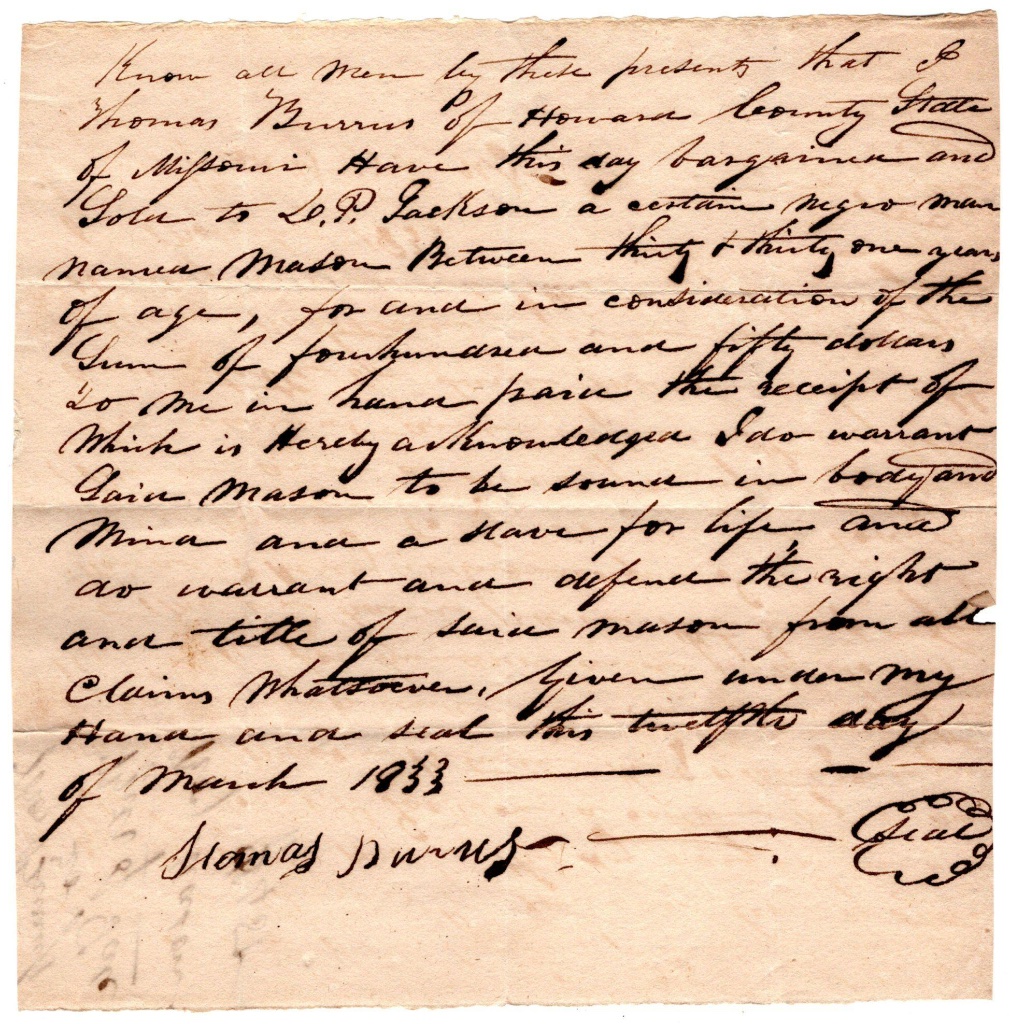
1833 Missouri Bill of Sale — Mason, Enslaved Man, Howard County (Thomas Burns to D.P. Jackson)
Know all men by these presents that I Thomas Burns of Howard County, State of Missouri have this day bargained and sold to D.P. Jackson a certain negro man named Mason between thirty and thirty-one years of age, for and in consideration of the sum of four hundred and fifty dollars to me in hand paid, the receipt of which is hereby acknowledged. I do warrant said Mason to be sound in body and mind and a slave for life and do warrant and defend the right and title of said Mason from all claims whatsoever. Given under my hand and seal this twelfth day of March 1833. Signed Thomas Burns. [Seal]

1835 South Carolina Slave Purchase Document
Source: University Archives https://www.universityarchives.com/auction-lot/1835-south-carolina-slave-purchase-document_F0792E7C25 Slavery Charleston, SC, February 28, 1835 1835 South Carolina Slave Purchase Document Partially printed DS A partially printed bill of sale between John Philips and William Freeman, both of Charleston, for "a Negro Slave named Peter about twenty four years of age." 1p, measuring 8" x 12.75", Charleston, SC, February 28, 1835. Within, Freeman purchases the aforementioned slave for a sum of six hundred and fifty dollars. The document is flush mounted to a separate sheet of archival paper, obstructing visibility of verso. Remnants of red wax seal present in the lower right. Exhibits areas of scattered soiling and dampstaining throughout, with moderate surface creasing. Minor paper loss at top right corner. Overall, good condition.

1848 Receipt for Sale of Slaves Advertisement
Source: University Archives https://www.universityarchives.com/auction-lot/1848-receipt-for-sale-of-slaves-advertisement_1A74FD1A21 Slavery 1848 Receipt for Sale of Slaves Advertisement Alabama 1848. Receipted bill for expenses incurred in the sale of slaves. Bill from George Carleton to Rev. P.J. Stevens, administrator of the estate of Mrs. Mary Stevens. Claims 5.00 for "Nov 13 To Adv Administrator's Sale of Negroes 2 squares 5 times / say ____ 5.00" . On faintly ruled paper, 6" x 3", lightly toned with expected folds. The advertisement occupied two squares and ran five times. Note at bottom that
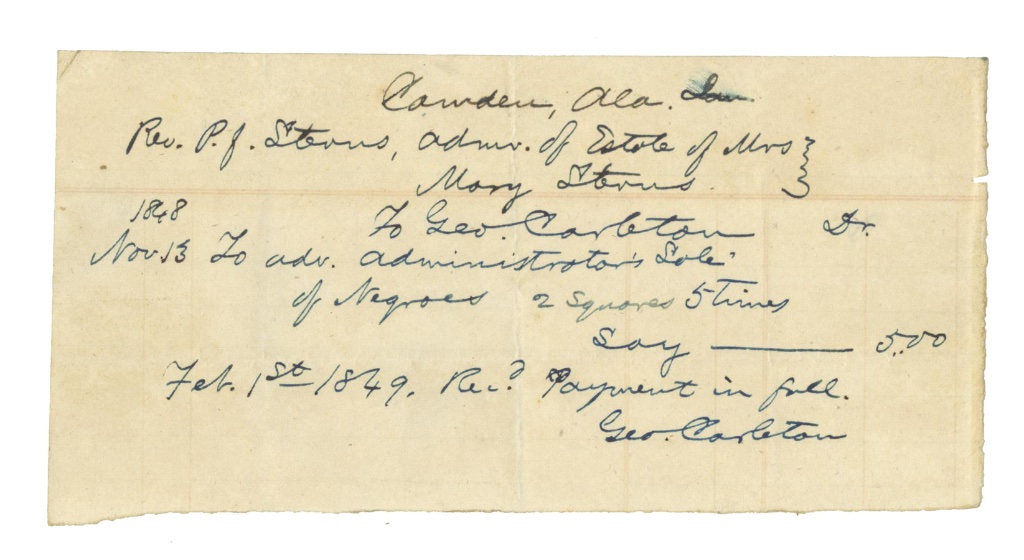
1848-1849 Camden, Alabama — Advertisement for Sale of Negroes (Geo. Carleton)
Receipt document from Camden, Alabama. Rev. P.J. Storms, administrator of Estate of Mrs. Mary Storms, to Geo. Carleton Jr. Dated Nov. 13, 1848 — advertisement for administrator's sale of Negroes, 2 squares 5 times. Payment received in full Feb. 1st, 1849. Signed by Geo. Carleton.

1852 Camden, Arkansas Bill of Sale for Slave with Sprained Ankle
Source: University Archives https://www.universityarchives.com/auction-lot/1852-camden-arkansas-bill-of-sale-for-slave-with-_D313265DE3 Slavery Camden, AR, May 24, 1852 1852 Camden, Arkansas Bill of Sale for Slave with Sprained Ankle ADS Autograph document recording the sale of a "negro Boy" slave with a sprained ankle in 1852. 1p 7.75" x 6", Camden, Arkansas, May 24, 1852. Paper has flattened folds, one tear/loss along the upper left edge, a water stain along the left edge impacting just one or two letters at the end, period ink smudging - else a nicely retained document in good condition. In full: "Rec'd Camden 24, May 1852 from Calvin M. Henry, five Hundred Dollars, infull for a negro Boy named Alfred. I guarantee the title to said negro, to the said Henry, and warrant him sound in mind and body, except a sprained ankle, which Alfred having been made known to the said Henry. I also warrant him to be a slave for life. Witness D.W. Fellows". Signed "Peter M. Collum". On the verso is the notation "Bill of Sale for Jack & Alfred" - there is no mention of Jack in the bill retained here.
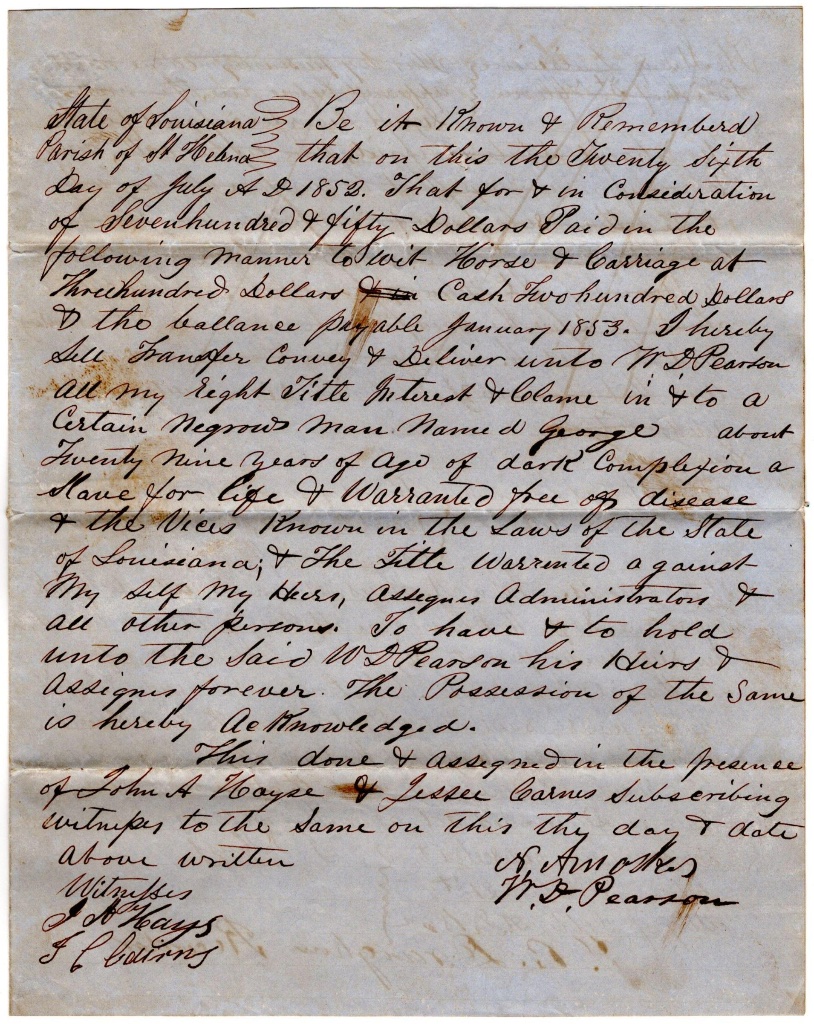
1852 Louisiana Bill of Sale — George, Enslaved Man, Parish of St. Helena (N.A. Moyes to W.D. Pearson)
State of Louisiana, Parish of St. Helena. Dated July 26, 1852. For $750 (horse & carriage at $300, cash $200, balance payable January 1853), N.A. Moyes sells, transfers, conveys and delivers unto W.D. Pearson all right, title, interest and claim in a certain Negro man named George, about 29 years of age, dark complexion, a slave for life, warranted free of disease and the vices known in the laws of the State of Louisiana. Title warranted against heirs, assigns, administrators and all other persons. Signed in presence of John A. Hays and Jesse Carnis. Signed N.A. Moyes and W.D. Pearson.

1855 Bill of Sale for Two 16-Year-Old Slave Girls
Source: University Archives https://www.universityarchives.com/auction-lot/1855-bill-of-sale-for-two-16-year-old-slave-girls_FDB431F990 1855 Bill of Sale for Two 16-Year-Old Slave Girls A pre-Civil War bill of sale for two young slave girls. 1p, measuring 7.75" x 6.25", n.p., dated October 12, 1855. Documentation of slavery ten years prior to the outbreak of the Civil War. The bill records the sale of "two negroes Girls to wit - Victoria of yellow complexion and about sixteen years of age at $1200 & Parthenia of dark complexion and sixteen years of age." Sold to A.J. Wood & Bro for $2,100 by William L. Boyd Jr. Also signed by two witnesses. The document has flattened folds, with separations repaired with tape on verso. Toning, staining, and soiling throughout. Minor chipping at the edges. Boldly signed.

1857 Bill of Sale for 4 Slaves in Savannah
Source: University Archives https://www.universityarchives.com/auction-lot/1857-bill-of-sale-for-4-slaves-in-savannah_CCAB49EB39 Slavery Savannah, GA, January 9, 1857 1857 Bill of Sale for 4 Slaves in Savannah Partially printed DS A partial printed bill of sale documenting the transfer of four slaves, ranging in age from eight months to twenty seven years. Savannah, GA, January 9, 1857. Within, one Davis Smith buys of E. Harrison "the following negroes to wit: Betty aged about twenty seven years, Ewannt aged about six years, Harriet aged about four years, and Moses aged eight months…" for a sum of $1,250. Exhibits uneven age toning and scattered soiling throughout, not affecting text. Closed tearing present near upper right, with light foxing in areas. Otherwise, very good. 1p, measuring 8" x 12.5", mounted to a stiff board on verso, measuring 8" x 13" overall. This lot comes with a Certificate from John Reznikoff, a premier authenticator for both major 3rd party authentication services, PSA and JSA (James Spence Authentications), as well as numerous auction houses.

African-American “slave for life” Sold to Farmer by Louisiana Cotton Planter
Source: University Archives https://www.universityarchives.com/auction-lot/african-american-slave-for-life-sold-to-farmer-by_1BC45BDBDD Slavery St. Helena Parish, LA, January 20, 1846 African-American "slave for life" Sold to Farmer by Louisiana Cotton Planter MDS [SLAVERY.] Hezekiah Thompson and Gabriel Lilley, Manuscript Document Signed, Bill of Sale for Slave Henry, January 20, 1846, St. Helena Parish, Louisiana. 2 pp., 8" x 12.5". Also signed by Notary Public S. B. Draughon and witnesses Daniel Newton and John Burton. Separation on several folds; general toning. With this bill of sale, cotton planter and future state legislator Hezekiah Thompson sold the enslaved man Henry to James Lilley for $600. Acting on behalf of Lilley was his son Gabriel Lilley (1814-1879), who had married a year earlier and was perhaps beginning his own farm with the aid of slave labor. Excerpt "Hezekiah Thompson...declared and acknowledged that for and in Consideration of the sum of six hundred Dollars to him in hand paid by James Lilley...Thompson has Bargained sold transfered and delivered unto the said James Lilly all his right title interest and claim in & to a Negro man named Henry of dark Complexion aged thirty eight years a slave for life and warranted free from all the vices and malides prescribed by Law...." Hezekiah Thompson (1797-1866) was born in central Virginia and served in the War of 1812. In 1819, he married Sarah Berry in St. Tammany Parish, Louisiana, and they had at least eight children. They lived for fifteen years in Covington, north of Lake Pontchartrain. In 1833, Thompson and his business partners purchased two steamers to transfer cargo and passengers across the lake to and from New Orleans. In the 1830s, Thompson purchased land in St. Helena Parish, forty miles northwest of Covington, and began to acquire a large number of slaves to operate a large cotton plantation there. He was elected to the Louisiana House of Representatives in 1852 By 1860, he owned 2,000 acres of land and 66 slaves. Politically, he was a Whig, then a member of the American Party in the mid-1850s. He supported the presidential aspirations of John Bell and Edward Everett of the Constitutional Union Party in 1860, then became a Democrat in 1862. James Lilley (1789-ca. 1851) was born in Virginia and married Nancy Lee. They had at least ten children, and by 1814 were living in Louisiana. He was a veteran of the War of 1812 and became a farmer in Louisiana.

Andrew Jackson demands payment for a slave before new owner lays claim.
Source: University Archives https://www.universityarchives.com/auction-lot/andrew-jackson-demands-payment-for-a-slave-before_C86459D938 Jackson Andrew 1767 - 1845 Andrew Jackson demands

Antebellum VA Probate Doc Mentioning Slaves Paris, Reuben, Billy, Nancy & Sally
Source: University Archives https://www.universityarchives.com/auction-lot/antebellum-va-probate-doc-mentioning-slaves-paris_E1546B2A50 Antebellum VA Probate Doc Mentioning Slaves Paris, Reuben, Billy, Nancy & Sally An 8pp probate document from Prince William County, Virginia dated November 1845 - March 1848, being a record of credits and debits on the estate of the deceased, Colonel John Hood, Jr. The ledger is a contemporary clerical copy that was probably produced and consulted during litigation involving an unresolved lien on the deceased's slaves. Handwritten in secretarial script on blue-lined paper with hand-ruled columns. The bifold paper bundles have been neatly sewn at the binding. Expected wear including flattened folds, light toning, and isolated fly specking, else extremely legible and near fine. 7.75" x 12.25." Colonel John Hood, Jr. of Prince William County, Virginia died sometime before November 27, 1845, the first entry of the probate doc. Prince William County is located in northeastern Virginia about 40 miles inland from Alexandria, Virginia and Washington, D.C. No genealogical records could be found for Colonel John Hood, Jr. (It is not believed that he is related to Confederate General John Bell Hood, whose family originated in Kentucky.) The last entry of Colonel Hood's probate ledger, a court addendum, is dated March 9, 1848. The probate ledger lists credits and debits to the estate of Colonel Hood. Commodities such as wheat, corn, apple trees, timothy seed, a pony, and clothing are listed. Costs relating to the deceased's coffin and funeral dinner can also be found. Farm work, slave hire, postage, legal expenses, and accrued interest are also itemized. The most interesting portion of the estate settlement, however, relates to Hood's slaves. These included children Paris, Billy, and Sally; two adults named Reuben and Nancy; and "two old slaves" who remain unnamed. While it was arranged that the elderly slaves were to be "kept for life" (page 1), the younger slaves were to be sold (page 6). In part: "To cash paid Thos B Garius for crying sale of slaves Reuben + Nancy " Do paid printers bill for attending sale of same By Do for negro boy Paris " Do " Negroes Reuben + Nancy interest " Do " " boy Billy…" (page 6) References to slaves in historical records are relatively common, but mentioning slave auctioneers by name are much rarer. This probate ledger contains several references to "crying sales," that is, estate auctions, and two auctioneers are mentioned, William S. Allen (page 1) and Thomas B. Garius (page 6).

Bill of Sale for Enslaved Man, Woman, and 18-Month-Old Child, Essex County, NJ (1836)
Source: University Archives https://www.universityarchives.com/auction-lot/northern-slavery-in-nj-unbelievable-sale-includes_D704EB08F8 Northern Slavery In NJ, Unbelievable Sale Includes 18mo Old Baby Cato! 1p, measuring 8" x 9.75", Essex County, New Jersey, dated July 28, 1836. A rare documentation of slavery being upheld in a northern state, just twenty-five years before the outbreak of the Civil War. The bill records the sale of a man and a woman into slavery, as well as baby boy. On verso, the document is labeled as "Bill of Sale of Negro Man & Woman in New Jersey 1836." Reading in part: "…I, William P. Ackerman of Acquackanonk County of Essex and State of New Jersey per and in consideration of the sum of two hundred and twenty dollars Lawful money to me…do grant bargain sell and deliver unto the said John A Post a black man named Will aged about fifty years and also a black woman named Flore aged about thirty five years the same to have and to hold during their natural lives…also a black male servant child named Cato of the age one year and six months the same to have and hold as a servant until he shall arrive to the age of twenty five years when by Law he becomes free…" With a small seal at the lower right, to the right of Ackerman's signature. The document has flattened folds, with separations and small tears at the edges. Uneven lower edge. Light edge toning and minor foxing throughout. After the American Revolution, the state of New Jersey banned the importation of slaves in 1788, and passed a law for the gradual abolition of slavery in 1804. Children born to slaves after July 4, 1804 were made to serve lengthy apprenticeships in service of their mothers' owners. Despite the fact that by the 1830s, slavery was on the decline, African Americans still made up 6% of the state's population. The Gradual Abolition Act of 1804 did not guarantee that a slave born after 1804 would gain their freedom, and slaveholders would regularly sell children to southern states before the slaves reached the age at which they were to be freed. It was not until 1846 that New Jersey abolished slavery, but it qualified that those who were born before the passage of the law were considered indentured servants "apprenticed for life". Slavery did not truly end in the state until the end of the Civil War and the passage of the Thirteenth Amendment.

Commissioner's Report: Sale of Enslaved People from the Bullock Estate, Muhlenberg County, KY (1852)
Source: University Archives https://www.universityarchives.com/auction-lot/slaves-sold-at-courthouse-door-by-mayor_4B240158FB Slavery Muhlenberg County, KY, June 2, 1852 Slaves Sold at Courthouse Door By Mayor! MDS [SLAVERY.] Thomas H. Crawford, Manuscript Document Signed, Commissioner's Report for Sale of Slaves from the Personal Estate of John Bullock, June 2, 1852, Muhlenberg County, Kentucky. 2 pp., 8" x 12.5". Expected folds; some separations on folds repaired with cellophane tape; very good. This 1852 report by Commissioner Thomas H. Crawford to the Muhlenberg County Court in Kentucky details the sale of a one-third interest in three enslaved African Americans owned by John Bullock at the time of his death in 1841. John Bullock's son Joseph Bullock held the interest, but the interest was sold after his death in 1851, likely to support his widow and children. His brother-in-law James Lewers purchased the third interest. Lewers lived in Louisville, Kentucky, with his wife, child, and widowed mother-in-law, Louisa Bullock. In 1850, she owned four slaves—a forty-year-old male, a thirty-eight-year-old female, a fourteen-year-old male, and a two-year-old male. It is likely that the first three are Charles, Polly, and Jasper, as mentioned in this document. Lewers owned only one slave, a fifteen-year-old female, who was likely a domestic servant. Muhlenberg County, formed in western Kentucky in 1798, was bordered on the northeast by the Green River and Ohio County. Slavery was an institution in Muhlenberg County from its earliest days. In 1800, there were 1,313 white inhabitants, 5 free African Americans, and 125 slaves in Muhlenberg County. By 1850, the white population of the county was 8,250, and there were 37 free blacks and 1,522 slaves. Complete Transcript Kentucky Muhlenberg County Court Bullocks admr vs Bullocks heirs & creditors The undersigned commissioner in said suit Reports, that in pursuance of the decree at the April term 1852 of said Court, after making due advertisement thereof according to said decree he proceeded on the second day of June A D 1852 at the Court house in Louisville Kentucky and before the front door thereof to sell to the highest bidder on a credit of two months the interest, being one third part, which Joseph Bullock now deceased had in the three slaves Charles, Polly and Jasper, subject to the dower right of Louisa Bullock, widow of John Bullock deceased, and James Lewers being the highest bidder for Charles at fifty one dollars, for Polly at fifty one dollars and for Jasper at forty eight dollars became the purchaser of each & all of said slaves; And thereupon executed his bond with Jame McBurnie surety, who is approved as good & sufficient for the said sums amounting to one hundred and fifty dollars payable to me as Commissioner two months after date of said sale: which bond is herewith returned: Whereupon at the request of said James Lewers I executed the bill of sale for said slaves to said James Lewers and his wife Sarah Ann during their lives then to the survivor for life and then to the heirs and assigns of the surviv

Female Cherokee Slave Ownership in 1844 Tennessee — Margaret Morgan v. McShea (12pp)
Source: University Archives https://www.universityarchives.com/auction-lot/female-cherokee-slave-ownership-in-1844-tennessee_95E4E89BC2 Outstanding 12pp legal document describing a court case in Monroe County, Tennessee involving Cherokee slave owner Margaret Morgan. Three 4pp bifold bundles, inscribed by law clerk James M. Broyles. Addresses case of Margaret Morgan (oratrix, Cherokee) vs. defendants John McShea and Gideon Morgan. Margaret Morgan claimed her slave Alsey and four of Alsey's children were illegally seized and sold after September 1844. Argues under Cherokee law the slaves were solely her property. References will dated December 14, 1828 bequeathing 'Negress' Alsey and two sons. Dated around September 19, 1844.

Griffin & Pullman Slave Bill of Sale, 1854
Source: University Archives https://www.universityarchives.com/auction-lot/griffin-pullman-slave-bill-of-sale-1854_85C480985F Slavery [Lexington, KY], December 28, 1854 Griffin & Pullman Slave Bill of Sale, 1854 DS A slave bill of sale issued by the Griffin & Pullman slave-trading firm. 1p, measuring 7.5" x 11.75", [Lexington, Kentucky], dated December 28, 1854. Entitled "A Sale Bill of the negroes belonging to the Estate of John McLennan deceased made December 28th 1854." Recording the sale of approximately twenty slaves. The account is certified and signed at the conclusion by Thomas C. Griffin. With flattened folds. Toning, staining, and foxing throughout. Small hole from a minor area of ink burn. Very good overall. In 1849, the Kentucky Legislature inadvertently aided the slave trade with the repeal of the Non-Importation Act of 1833. The legislature also made it so that traders who had violated the 1833 Act would now be absolved from punishment. Slavery once again became an open trade in Kentucky, and it was not uncommon to see numerous newspaper advertisements of traders, such as Griffin & Pullman. By the end of 1858, it was said that there were as many slave dealers as there were mule traders.

Griffin & Pullman Slave Bill of Sale, 1854
A slave bill of sale issued by the Griffin & Pullman slave-trading firm. 1 page, measuring 7.5" x 11.75", Lexington, Kentucky, dated December 28, 1854. Entitled "A Sale Bill of the negroes belonging to the Estate of John McLennan deceased made December 28th 1854." Recording the sale of approximately twenty enslaved persons. The account is certified and signed at the conclusion by Thomas C. Griffin. Condition: flattened folds, toning, staining, and foxing throughout, small hole from a minor area of ink burn.

Letter Regarding Enslaved People in an Estate Dispute, Lynchburg, VA (1845)
Source: University Archives https://www.universityarchives.com/auction-lot/fascinating-slave-sale-letter-lynchburg-va_3DB45A2AEF Autograph letter signed by Ambrose Gills, 1p, 7.5" x 12.5", Gallipolis, OH, October 12, 1845. Addressed to John F. Hawkins of Lynchburg, Virginia, regarding slave issues and his father's estate. Gills instructs Hawkins to watch his brother John, who may be claiming enslaved people from the estate without a proper Bill of Sale. Postmarked from Gallipolis, stamped PAID. Remnants of red wax seal.

Louisiana Slaveowner Sells a Slave for Horse, Carriage, and Cash
Source: University Archives https://www.universityarchives.com/auction-lot/louisiana-slaveowner-sells-a-slave-for-horse-carr_9844B18928 Louisiana Slaveowner Sells a Slave for Horse, Carriage, and Cash With this bill of sale, Nathaniel Amacker sold a slave to Dr. William D. Pearson for $750, paid with a horse and carriage worth $300, $200 in cash, and a promissory note for the balance of $250. Amacker warranted that the slave George was free of both disease and " the Vices known in the Laws of the State of Louisiana ." Much of the Louisiana Civil Code came from the 1804 French Code Napoleon, in contrast to the English common law origins of laws in most American states. It divided the defects of slaves into "vices of body" and "vices of character." Articles in the Civil Code declared, "The absolute vices of slaves are leprosy, madness, and epilepsy.... The vices of character which give rise to the redhibition [invalidation of sale] of slaves, are confined to the cases in which it is proved: That the slave has committed a capital crime; Or, that he is addicted to theft; Or, that he is in the habit of running away, when he shall have absented himself from his master’s house twice for several days, or once for more than a month." [SLAVERY.] Nathaniel Amacker, Autograph Document Signed, Bill of Sale, July 26, 1852, St. Helena Parish, Louisiana. 1 p., 7.75" x 10". Expected folds; very good. Complete Transcript State of Louisiana / Parish of St. Helena Be it Known & Remembered that on this the Twenty Sixth Day of July A D 1852, That for & in Consideration of Seven hundred & fifty Dollars Paid in the following manner to wit Horse & Carriage at Three hundred Dollars Cash Two hundred Dollars & the ballance payable January 1853, I hereby Sell Transfer Convey & Deliver unto W D Pearson all my right Title Interest & Clame in & to a Certain Negrow man named George about Twenty nine years of age of dark Complexion a Slave for life & warranted free of disease & the Vices known in the Laws of the State of Louisiana; & The Title Warranted against My Self My Heirs, Assignes Administrators & all other persons. To have & to hold unto the said W D Pearson his Heirs & assignes forever The Possession of the same is hereby Acknowledged. This done & assigned in the presence of John A. Hayse & Jessee Carnes Subscribing witnesses to the same on tis the day & date above written N Amacker  

Louisiana Slaveowner Sells Four Young Slave Women to Nephews of One of Largest Slaveowners in the State
Source: University Archives https://www.universityarchives.com/auction-lot/louisiana-slaveowner-sells-four-young-slave-women_73F42A19BF Louisiana Slaveowner Sells Four Young Slave Women to Nephews of One of the Largest Slaveowners in the State In this document, Notary Public Lucien Hermann notarizes the sale of four young enslaved women to brothers James and Elias J. Hoover, who were living with their uncle and tutor Jacob Hoover, who was on his way to becoming one of the largest slaveowners in Louisiana. By the time of his death in 1859, he owned approximately five hundred human beings. [SLAVERY.] Lucien Hermann, Partially Printed Document Signed, Copy of Bill of Sale, February 29, 1844, Concordia Parish, Louisiana. 4 pp., 8.5" x 14". Some toning; ink somewhat light; good. Excerpts " Personally appeared, Chandler Lewis a resident of in the State of Missouri who declared that for the consideration hereinafter expressed he has sold…Unto James and Elias Hoover, now living with their uncle and tutor Jacob Hoover of the Parish of Concordia in this State the four following slaves to Wit. 1 Elizabeth a negro woman, aged twenty one years 2 Clarissa a negro woman, aged eighteen years 3 Mary Jane a negro woman aged twenty years 4 and Lavinia a negro woman aged twenty two years which said slaves are the true and lawful property of the said vendor, and were by him lately introduced in this State ." " The present sale is made and accepted for and in consideration of the price and sum of Six hundred dollars for the slave Elizabeth, Six hundred dollars for the slave Clarissa, Five hundred and fifty Dollars for the slave Mary Jane, and Five hundred and fifty Dollars for the slave Lavinia, amounting to the sum of Two thousand and three hundred Dollars, which the said vendor hereby acknowledges to have received in ready current money from Mr Thomas Byrne of this City for account of Jacob Hoover tutor of the said purchasers. " Lucien Hermann (1811-1885) was born in Louisiana. He served as a notary public in Concordia Parish, Louisiana, and was an active Mason. He married Mary Anne Clarke (1820-1899) in 1850, and they moved to San Francisco, California, where he worked as a clerk in a broker office by 1870. Chandler Lewis (1808-1882) was born in Connecticut and moved to Louisiana by the 1830s. In January 1846, he married Charlotte Cloud (1829-1907) in Franklin Parish, Louisiana, where he lived for the rest of his life. They had at least eight children between 1847 and 1865. Jacob Hoover (1803-1859) was born in Georgia. He became a planter in Concordia Parish, Louisiana, where he purchased the Whitehall plantation on the Mississippi River in 1830. By 1850, he owned 83 slaves and $235,000 worth of real estate. By the time of his death, he owned two plantations and approximately five hundred slaves. Elias J. Hoover (ca. 1830-aft. 1880) was born in Louisiana. At his uncle's death in 1859, he and attorney and future Confederate general Zebulon York (1819-1900) inherited his uncle's estate, which consisted of two plantations and approximately five hundred slaves. By 1860, Hoover owned 236 slaves in Conco

Nautilus Insurance Company: Death Benefits Ledger, 1845–1888 (Schomburg Center)
A ledger documenting insurance death claims paid by the Nautilus Insurance Company (predecessor of New York Life Insurance Company), which sold life insurance policies to enslavers to insure enslaved persons against death between 1845 and 1848. The word "slave" was written in red ink in the "year of issue and age" column for enslaved persons. Records include loss number, policy number, date of death, amount paid, and policy year. This record is particularly significant for genealogical research — the insured enslaved persons are listed by name with ages, dates and places of death, and the names of the enslavers who held the policies. Source: Schomburg Center for Research in Black Culture, Manuscripts, Archives and Rare Books Division, The New York Public Library Collection: Nautilus Insurance Company Slavery Era Ledgers (Sc MG 715) https://digitalcollections.nypl.org/items/c9071810-5884-013b-8b2b-0242ac110002

Nautilus Insurance Company: Index to Applicants A–K, ca. 1845–1888 (Schomburg Center)
An alphabetical index of insurance applicants A through K for the Nautilus Insurance Company (predecessor of New York Life Insurance Company), covering the full life of the company from ca. 1845 through April 1, 1888. Each entry lists the applicant's name, loss number, policy number, date of death, amount paid, year of issue, and age of insured. This index is a critical finding aid for locating enslaved persons and enslavers in the accompanying policy registers and death claim books. Applicants include both free and enslaved persons. Source: Schomburg Center for Research in Black Culture, Manuscripts, Archives and Rare Books Division, The New York Public Library Collection: Nautilus Insurance Company Slavery Era Ledgers (Sc MG 715) https://digitalcollections.nypl.org/items/ca682c00-5884-013b-7bc1-0242ac110002

Nautilus Insurance Company: Index to Applicants L–Z, ca. 1845–1888 (Schomburg Center)
An alphabetical index of insurance applicants L through Z for the Nautilus Insurance Company (predecessor of New York Life Insurance Company), covering the full life of the company from ca. 1845 through April 1, 1888. Each entry lists the applicant's name, loss number, policy number, date of death, amount paid, year of issue, and age of insured. This index is a critical finding aid for locating enslaved persons and enslavers in the accompanying policy registers and death claim books. Applicants include both free and enslaved persons. Source: Schomburg Center for Research in Black Culture, Manuscripts, Archives and Rare Books Division, The New York Public Library Collection: Nautilus Insurance Company Slavery Era Ledgers (Sc MG 715) https://digitalcollections.nypl.org/items/cc0ff790-5884-013b-31a9-0242ac110002

Nautilus Insurance Company: Policy Register 5–1000, Vol. 1, 1845–1847 (Schomburg Center)
The first policy register of the Nautilus Insurance Company (predecessor of New York Life Insurance Company), covering policy numbers 5 through 1000, dating from December 24, 1845 through 1847. Of the first one thousand policies written by Nautilus, 339 were on the lives of enslaved persons, typically written for less than $500 for a term of one year. Each entry includes: policy number, date, applicant name and residence, name of the insured (including enslaved persons) with residence, age, and occupation, amount insured, premium, annual payment, term length and expiration date, and remarks. Company bookmarks marking pages with enslaved persons' policies have been left in place. Source: Schomburg Center for Research in Black Culture, Manuscripts, Archives and Rare Books Division, The New York Public Library Collection: Nautilus Insurance Company Slavery Era Ledgers (Sc MG 715) https://digitalcollections.nypl.org/items/c1acc540-5884-013b-80af-0242ac110002

New Orleans Slave Market Bills of Sale Illustrate Internal Slave Trade
Source: University Archives https://www.universityarchives.com/auction-lot/new-orleans-slave-market-bills-of-sale-illustrate_F614AF2A58 New Orleans Slave Market Bills of Sale Illustrate Internal Slave Trade [SLAVERY.] Two Manuscript Bills of Sale for slaves sold in New Orleans 1856, 1861. 7 pp., 8.5? x 14?. The second is a copy certified by the Notary Public. Expected folds; some minor fold tears; both have embossed seals of notaries public; very good. Excerpts: May 26, 1856, before Octave de Armas, Notary Public: Mr John Foretich, of the Said City, who declared that for & in consideration of the Sum of Four-hundred & fifty Dollars ($450) to him in hand paid cash...does by these presents, Sell, convey, assign, transfer & set over, with all legal warranties, & with subrogation to all his rights of action & warranty against all preceding vendors or proprietors Unto Mrs Helene Ward, wife of John Ochiglevich, & by him hereto & herein duly assisted & authorized a certain negress slave, named Marie Thereze aged about 38 years; fully guaranteed against the vices & diseases prescribed by law, with the exception of the vice of drunkenness to which the said slave is declared to be somewhat addicted; which said slave belongs to the said John Foretich by means of the purchase he made thereof from Mrs Eliza Deckery, wife of Alexander Benjamin, as per act passed on the 16th December 1853.... And the said Mrs Helen Ochiglevich presently declared, and her said husband does hereby acknowledge that the purchase of said slave is made for her personal & exclusive advantage; the price thereof being paid out of the paraphernal funds belonging to her & coming from her private labor & industry. January 29, 1861, before James Graham, Notary Public: Julian Neville, of this City, herein acting as the agent of James B. Smith of the City of Mobile and State of Alabama...declared, that for and in consideration of the price and sum of Seven Hundred Dollars ($700 00/100) to him in hand well and truly paid in ready money by John Ochiglevich...does by these presents, in his said capacity, grant, bargain, sell, and convey with all legal warranties unto the said Ochiglevich...A certain negro man, a slave for life named Willis, aged about twenty years. Said Slave is guaranteed in no respect save and excepting the title thereto, he having been in the habit of running away from his said Masters Residence near Mobile to that City, and not being perfectly sound in body.... Said slave is the true and lawful property of the said Smith, as his said agent hereby declares, the same having been recently imported into this State from the State of Alabama. Historical Background: New Orleans had a notoriously thriving market for the sale of human beings in antebellum America. In many areas of the South, masters threatened their slaves with being sold to New Orleans if they were rebellious or frequently ran away, as Willis, sold in 1861, evidently did while enslaved near Mobile. The husband-and-wife purchasers of these slaves, Austrian-born John Ochiglevich (1811-1883) and Ir

Northern Bill of Sale for a Slave, Purchased by Future NJ Governor
Source: University Archives https://www.universityarchives.com/auction-lot/northern-bill-of-sale-for-a-slave-purchased-by-fu_8A64866B4B Northern Bill of Sale for a Slave, Purchased by Future NJ Governor 1p, measuring 8" x 12", Somerset, New Jersey, dated June 15, 1807. A bill of sale for a slave between Jocham Quick and future New Jersey governor, Peter Dumont Vroom. Reading in part: "I Jocham Quick…for the sum of three hundred dollars, have and do bargain and sell to Peter D. Vroom…a negro man named Sam…And I do warrant and will defend the said Peter D. Vroom in the peaceable possession of the said negro man against me and all persons whatsoever." Signed by Quick and witnessed by John Pittenger. With a paper embossed seal at the middle right edge. The document has flattened folds, with toning and light mat burn. Rough edges. Evidence of mounting residue on verso. Boldly signed. Overall, very good. Although New Jersey banned the importation of slaves in 1788, slavery wasn't fully abolished until nearly 80 years later. New Jersey was the last state in the North to abolish slavery, passing a gradual abolition law in 1804. Children born after 1804 were freed, but some still had to serve apprenticeships to the owners of their mothers. Female slaves were freed at the age of 21 and males were freed at 25. Those slaves who were born before 1804 were to be considered as indentured servants "apprenticed for life." Slavery in the state would not officially end until 1865 when the Thirteenth Amendment was passed. Peter Dumont Vroom (1791-1873) served as the ninth governor of New Jersey from 1829–1832 and 1833–1836, and later as a member of the United States House of Representatives from 1839–1841. He graduated from Columbia College in 1808, meaning that he purchased the above-recorded slave while he was still in school. Records show that Vroom owned several slaves during the course of his life.

Pre-Civil War Slavery Records from Alabama, 1828–1862 (Archive of ~20 Documents)
Source: University Archives https://www.universityarchives.com/auction-lot/fantastic-pre-civil-war-slavery-archive-from-acro_A3B40AAB74 Fantastic Pre-Civil War Slavery Archive from Across the State of Alabama This small archive of approximately 20 documents includes materials related to slaves, including the sale and renting of slaves and their valuation in estates at the death of their owners. Together, they offer a poignant reminder of the history of owning persons as property. [SLAVERY.] Archive of documents related to slavery in the United States, 1828-1862. Expected folds; varying degrees of toning and soiling; some dampstaining; some edge tears; very good. A sampling of the archive includes the following items: Receipt for the Hiring of Slaves. 2pp, measuring 7.75" x 5.25", no place [Alabama], dated June 18, 1855. On bluish tinted ruled paper, an executrix of an estate is reimbursing the manager, or caretaker, for the "hire of three negroes, Sam, Laggio and Dafney for the year 1854, $200.00." Note appended confirms receipt of

Rental of Slave Louisa in 1864, as Slavery Draws to a Close
A promissory note in which A.J. Tenant agreed to rent the enslaved woman Louisa for $70 for the year 1864 from John H. Wills. 1 page, 8" x 3", dated December 22, 1863. The document reads: "I promise to pay John H. Wills or bearer the sum of seventy dollars for the hire of a negro woman (Louisa). Jan 1st 1865. A J Tenant. Dec 22nd 1863." On the verso: "Recd of Geo. M. [Ha?] Seventy Dollars and Ninety Cents on the within note Feb 9th 1865. M. A. Wills." The $70.90 payment recorded on February 9, 1865 — after emancipation — suggests either John H. Wills or Tenant had died. Condition: expected folds; very good.

Revolutionary War Veteran Sells Slave in Missouri
Source: University Archives https://www.universityarchives.com/auction-lot/revolutionary-war-veteran-sells-slave-in-missouri_9AF49A79C9 Revolutionary War Veteran Sells Slave in Missouri With this bill of sale, Thomas Burrus sold a thirty-year-old slave named Mason to L. P. Jackson in Howard County in central Missouri. [SLAVERY.] Thomas Burrus, Manuscript Document Signed, Bill of Sale, March 12, 1833, Howard County, Missouri. 1 p., 7.75" x 12.75". Some toning; very good. Complete Transcript Know all men by these presents that I Thomas Burrus of Howard County State of Missouri Have this day bargained and sold to L. P. Jackson a certain negro man named Mason Between thirty & thirty one years of age, for and in consideration of the sum of four hundred and fifty dollars to me in hand paid the receipt of which is Hereby acknowledged I do warrant said Mason to be bound in body and Mind and a slave for life and do warrant and defend the right and title of said Mason from all claims whatsoever. Given under my Hand and seal this twelfth day of March 1833. Thomas Burrus (seal) Thomas Burrus (1771/74-1849) was born in Virginia. During the Revolutionary War, he served as a sergeant in the 3rd Virginia Regiment. In 1790, he lived in North Carolina, and in 1800 in Kentucky. In 1803, he married Mary Ann Mills Meade (1780-1846), and they had at least nine children. By 1830, Burrus had moved to Howard County in central Missouri. In 1840, he owned ten slaves. In 1847, he married Nancy Hughes Price (1783-1859), and they were married for fourteen months before his death.

Sale of Teenaged Slave Girl in Colonial Connecticut
Source: University Archives https://www.universityarchives.com/auction-lot/sale-of-teenaged-slave-girl-in-colonial-connectic_51D4638A58 Slavery Norwich, CT, May 14, 1761 Sale of Teenaged Slave Girl in Colonial Connecticut MDS [SLAVERY.] Ebenezer Fitch, Manuscript Document Signed, Bill of Sale for slave Nancy, May 14, 1761, Norwich, Connecticut. 1 p., 8" x 11.875". Some small holes on folds, not affecting text; small separations on several folds; personal wax seal intact. This bill of sale records the transfer of the ownership of Nancy, a seventeen-year-old enslaved girl, from Ebenezer Fitch to his brother-in-law Isaac Huntington for £40. Isaac Huntington's brothers Elijah Huntington (1734-1814) and Benjamin Huntington Jr. (1736-1801) signed the document as witnesses. Benjamin Huntington Jr. served as Norwich town clerk from 1765 to 1801. Complete Transcript Know all Men by these Presents that I Ebenezer Fitch of Norwich in the County of Newlondon and Collony of Conneticut for the Consideration of Forty Pound Lawful money to me In hand Paid by Isaac Huntington Esqr of sd Norwich the Receipt Whereof I hereby Acknowledge I the sd Ebenezer Fitch Do therefore In consideration above I Do Bargain Sell & Convey unto him the sd Isaac Huntington Esqr and to his Heires and assigns one Carting Negro Girl Named Nancy of about Seventeen Years of Age a Slave to be the Property of him the sd Isaac Huntington Esqr his heirs & assigns During her Natural Life to have to hold Said Negro Slave as his onley Property & to sd only Benefits to him the sd Isaac Huntington Esqr his Heirs and assigns During her Natural Life as above sd and I the sd Ebenezer Fitch Do for my Self & my Heires Covenant and agree to and with the sd Isaac Huntington his Heires & assigns that I ame the Sole and Lawful owner of sd Negro Slave and that I have Good Right and Lawfull Authority to Bargin and Sell sd Slave In manner & Form above Written and Fothermore I the sd Ebenezer Fitch Do Bind my Self and my heirs to Warrant and Defend the sd Negro Slave unto him the sd Isaac Huntington Esqr and his heirs & assigns for Ever against all Lawfull Clames & Demands What Ever In Wittness Whereof I the sd Ebenezer Fitch have herby Sett my Hand & Seal the 14th Day of May AD 1761 Ebnezr Fitch [seal] Singned Seald In presents of Elijah Huntington Benj. Huntington [File Note on Verso:] Bill of Sale of Nancy Historical Background Slavery in Connecticut began in the seventeenth century and remained legal throughout the eighteenth century, but the state legislature acted to restrict it in the last quarter of the century. The colony prohibited the further importation of slaves in 1774. A decade later, in the wake of the Revolutionary War, the Connecticut General Assembly approved a plan of gradual emancipation by which all slaves born after March 1, 1784, would become free at age 25 for males and age 21 for females. If she were still alive and in Connecticut in 1784, this act would not have helped Nancy, who would have been around 40 when it was passed. In the mid-1770s, there were approximately 5,100 enslaved

Slave Traders Sell Slave to One of the Early Settlers of Spanish Natchez
Source: University Archives https://www.universityarchives.com/auction-lot/slave-traders-sell-slave-to-one-of-the-early-sett_757488C8EE Slave Traders Sell Slave to One of the Early Settlers of Spanish Natchez With this bill of sale, slave traders Warren Offutt and Rice C. Ballard sold a twenty-one-year-old slave named Aaron to John Henderson of Natchez, Mississippi. On the same day, Henderson advertised an auction of ten slaves in two families from the estate of Norman McInnis of Concordia, Louisiana, to be sold at auction on January 2, 1829. Three years later, he wrote a letter to the editors of the National Intelligencer in Washington, D.C., for publication that suggested a method for the gradual abolition of slavery, although it may not have been published, as he wrote six weeks later asking their reasons for "suppressing it." [SLAVERY.] Warren Offutt and Rice C. Ballard, Manuscript Document Signed, Bill of Sale, December 27, 1828, Natchez, Mississippi. 1 p., 7.75" x 12.75". Some toning; very good. Complete Transcript Know all men by these presents that we Warren Offutt & Rice Ballard for and in consideration of the sum of five hundred Dollars to us in hand paid by John Henderson of the City of Natches the receipt whereof is hereby acknowledged have bargained sold and delivered and by these presents do bargain sell and deliver to the said John Henderson One Negro Man named Aaron about twenty one years of age and we do hereby warrant the said Negro Man as a slave for life to the said John Henderson his heirs and assigns against the legal claim of all and every person or persons whomsoever and do also warran[t] the said Negro Man to be at this time bound in mind and body. In witness whereof we have hereunto set our hands and seals at Natches this twenty seventh day of December 1828 Witness Warren Offutt (seal) R. C. Ballard (seal) Warren Offutt (1780-1856) was born in Maryland and married Clarissa Offutt in 1810. He moved to Kentucky by 1820 and worked as a slave trader in the Mississippi Valley. In 1833, he paid $65 in taxes in Natchez, Mississippi, as a 1 percent tax on gross sales for six months, indicating that he had sold $6,500 worth of slaves in that half year. By 1850, he was a farmer in Lafayette County, Missouri. Rice C. Ballard (1800-1860) was born in Fredericksburg, Virginia, and became a slave trader based in Richmond, Virginia. He worked in partnership with the large slave trading firm of Isaac Franklin and John Armfield in the late 1820s and early 1830s. By the early 1840s, Ballard became a planter in the Mississippi Valley, but he made his home in Louisville, Kentucky. He married Louise Berthe (1826-1896) around 1840, and they had three children. By the late 1850s, Ballard owned more than five hundred slaves. John Henderson (1755-1841) was born in Scotland and emigrated to Norfolk, Virginia, in 1770. He moved to Louisiana in 1775, and then settled in Natchez, Mississippi, in 1787. There, he became a prosperous merchant; in January 1821, his firm became John Henderson and Sons, when his sons Alexander and Thomas joined him in partnership. At various times duri

Slavery Bill of Sale from Antebellum New Orleans for "Alfred, an orphan boy, aged about seven years"
Source: University Archives https://www.universityarchives.com/auction-lot/slavery-bill-of-sale-from-antebellum-new-orleans-_BAD4B0B92C Slavery Bill of Sale from Antebellum New Orleans for "Alfred, an orphan boy, aged about seven years" A legal document from antebellum New Orleans recording details about the sale of a 7-year-old slave named Alfred. The original document of which this is a true copy was dated December 18, 1854 in New Orleans, Louisiana; the clerical duplicate dated January 13, 1855 was signed by the Notary Public Adolphe Boudousquié and embossed with his seal on the fourth page. Partly printed and partly handwritten on pale blue legal-sized bifold paper. Expected paper folds and scattered holes corresponding to old folds. A few chipped and darkened edges. Isolated weathering to the last page, else very good to near fine. 8.5" x 13.75." A New Orleans resident named David McDuffee sold a 7-year-old boy named Alfred to another city resident named Albert Little Abbott for $500. McDuffee had purchased Alfred from three individuals, Thomas Pace, the widow of Thomas Pace, and the wife of Thomas Towns, about one year earlier, in January 1854. In part: "In the City of New Orleans, in the state of Louisiana. This Eighteenth day of December eighteen hundred and fifty four and in the seventy ninth year of the Independence of the United States of America, Before me, Adolphe Boudousquié, Notary Public, duly Commissioned and Sworn, in and for this City and the Parish of Orleans, therein residing, and in the presence of the Witnesses hereinafter named and undersined [sic]. Personally came and appeared: Mr. David McDuffee of this city, Who declared that for and in consideration of the price and sum of Five Hundred Dollars, to him in hand well and truly paid, by Albert Little Abbott, also of this city, the receipt whereof is hereby acknowledged, and acquittance thereof granted… [of] A slave named Alfred, an orphan boy, aged about seven years, lawfully belonging to said vendor by means of purchase…" The average price of a slave in 1855 was $600. This represented about 6 times more than the average annual salary earned during that period. Slaves fetched higher prices in the "New South," in markets like New Orleans, compared to the "Old South," or the mid-Atlantic states. Even with this inflation, the 7-year-old slave named Alfred would have cost less than an enslaved man in the prime of his youth, or an enslaved woman of child-bearing age. This was because the slave owner had the initial outlay of the care of the boy before it could be recouped upon the slave's reaching working age. Albert Little Abbott (1823-1901), the man who purchased Alfred, had moved to New Orleans in the 1840s from New England. Abbott became one of the most respected diamond experts in New Orleans, working for more than five decades in a jewelry store on Canal Street, at the edge of the French Quarter. Abbott's obituary recounts that he was also a Free Mason and was actively involved in the construction of the New Orleans and Carrollton Street Railway.

Slavery Records Archive: Sales, Rentals, and Estate Valuations, 1829–1863 (10 Documents)
Source: University Archives https://www.universityarchives.com/auction-lot/slavery-archive-of-10-items_6844B4B94D Slavery Archive if 10 Items This small archive includes materials related to slaves, including the sale and renting of slaves and their valuation in estates at the death of their owners. Together, they offer a poignant reminder of the history of owning persons as property. [SLAVERY.] Archive of documents related to slavery in the United States, 1829-1863. Expected folds; some edge tears; very good. Francois Gardère, Partially Printed Document Signed as State Treasurer, Receipt for Taxes paid by Vr Canchoix, on 3 slaves for 1828, October 3, 1829, Louisiana. 1 p., 6.5? x 2.875? Joseph Goodwyn, Autograph Letter Signed, to Unknown, May 19, 1835, Sappony, [North Carolina?]. 1 p., 4? x 6.5?: I will see that the negroes you levy on shall be delivered to you on the day you may appoint for their sale. The death of a master often led to the sale of slaves to settle the debts of an estate. Joseph Goodwyn (1780-1838) of Dinwiddie, Virginia, owned 119 slaves in 1830. E. D. Williams, Administrator of estate of L. B. Griggs, Manuscript Document, Debts for hire of six slaves for the year 1840 for a total of $687, July 1, 1840. 1 p., 7.75? x 6.5?. William H. Stewart, Receipt for

Tennessee Couple Sells a Slave to Merchants for $900
Source: University Archives https://www.universityarchives.com/auction-lot/tennessee-couple-sells-a-slave-to-merchants-for-9_33BA804B45 Slavery Spring Creek, Tennessee, October 12, 1853 Tennessee Couple Sells a Slave to Merchants for $900 MDS With this bill of sale, William and Rebecca Lyon sold a slave girl for $900, to merchant partners Corry Pettigrew and Jesse Gray in Spring Creek, in western Tennessee. [SLAVERY.] William T. Lyon and Rebecca Lyon, Manuscript Document Signed, Bill of Sale, October 12, 1853, Spring Creek, Tennessee. 1 p., 7.75" x 4.125". Expected folds; very good. Complete Transcript We have this day bargained and Sold to Messrs. Pettiegrews & Gray for the Sum of Nine Hundred ($900) Dollars the receipt of which is hereby acknowledged, a certain Negro Girl named Padilee, Seventeen Years Old. We bind ourselves our heirs Executors &c to warrant and defend the title to said girl, and warrant her Sensible and a Slave for life. Spring Creek, Tenn. Oct 12th 1853 Attest Cyrus Sikes Jno. S. Hill Wm. T. Lyon her Rebecca X Lyon Mark William T. Lyon (ca. 1811-1872) was born in North Carolina. He married Rebecca W. Webster (1813-1879) in 1831, and they had at least seven children. In 1850, he was a farmer in Madison County, Tennessee, where he owned $400 in real estate. By 1860, he had increased his real property to $2,000. In 1870, he owned $4,000 in real estate. His obituary described him as "an old and worthy citizen, a man of great industry, and of unimpeachable integrity." Corry Pettigrew (1800-1870) was born in Ireland and immigrated with his brother in the early 1820s to South Carolina, where they constructed canals and ditches for irrigation. They later established a merchant business in Alabama before moving in 1825 to Tennessee. They established a store at Spring Creek, Tennessee. In 1840, Pettigrew married Mary A. Douglas (1822-1892), and they had two children. In 1850, he was a merchant in Madison County, Tennessee. In 1860, he was a merchant and farmer in Decatur County, Tennessee, with $45,000 in real estate and $225,000 in personal property, including 58 slaves. He died in Decatur County, Tennessee. Jesse Taylor Gray (1812-1879) was born in Tennessee. In 1847, he married Caroline Mooring (1828-1886), and they had at least six children. Gray served as the postmaster of Spring Creek, Tennessee, from 1844 to 1848, and also served as mayor. He entered into a mercantile partnership with Corry Pettigrew for a time. In 1850, he was a merchant in Madison County, Tennessee, where he had real property worth $1,500 and owned four slaves. In 1860, he owned $3,600 in real estate and $20,000 in personal property, including 11 slaves. Between 1862 and 1870, he moved to Lake County, Tennessee, where he operated a store.

Unusual South Carolina Slave Sale Arranged by Former Slave, One of the Wealthiest Ex-Enslaved Slaveholders of The State!
Source: University Archives https://www.universityarchives.com/auction-lot/unusual-south-carolina-slave-sale-arranged-by-for_48F43BB923 Unusual South Carolina Slave Sale Arranged by Former Slave, One of the Wealthiest Ex-Enslaved Slaveholders of The State! A 1p contemporary clerical copy of a bill of sale recording the sale of a "negro man slave named Frank," an agreement made between two town residents named William Ellison and Thomas Waties. December 5, 1854, Stateburg, South Carolina. On pale blue laid paper. The document is signed by E.M. Anderson, a Stateburg citizen, at lower left, and is secretarially signed by the seller, William Ellison, at lower right. Docketed verso. Expected wear including paper folds as well as isolated corner wrinkles and weathering verso. Else near fine. 7.875" x 12.125." The bill of sale reads in part: "State of South Carolina Know All men by these Presents that I William Ellison for and in consideration of the sum of nine Hundred Dollars to me in Hand paid by Thomas Waties (the receipt thereof I do hereby acknowledge) have bargained sold and delivered and be these Presents do bargain sell and deliver to the said Thomas Waties a certain negro man slave named Frank - To Have and to Hold the said negro slave Frank unto the said Thomas Waties his Heirs Executors Administrators and Assigns… In witness whereof I have hereunto set my Hand and Seal dated at Stateburg on the Fifth day of December in the Year of Our Lord one Thousand eight Hundred and fifty four…" Stateburg, South Carolina is located in Sumter County, in the center of the state, in a region dominated by the High Hills of Santee. Stateburg was also the adopted home of William "April" Ellison, Jr. (ca. 1790-1861), after 1816. Ellison, Jr. was destined to become one of the wealthiest free black slave owners of antebellum South Carolina. "April" Ellison was the illegitimate son of a white slave owner named William Holmes Ellison (1775-1833) from Fairfield County, South Carolina and an enslaved black woman. Ellison, Jr. was born into slavery and grew up as a slave. He was apprenticed to a cotton gin maker, who provided him with a basic education (arithmetic, writing, and reading) and also taught him invaluable trade skills in machinery, blacksmithing, and carpentry. Ellison, Jr. had saved enough of his "hiring out" wages to purchase his freedom around the age of 26, which is also around the time that he legally changed his name from April (the month that he is believed to have been born) to William Ellison, Jr. William Ellison, Jr. quickly took advantage of his new-found manumission. He opened a cotton gin manufactory and repair shop in Stateburg, and, to operate it, he acquired highly skilled artisan slaves like he himself had been. He was so successful over the next 40 years that in 1860, the year before his death, Ellison, Jr. is recorded as owning about 900 acres of land and 63 slaves, or the equivalent of $53,000 in 1860 money and nearly $2 million in 2022 currency. Ellison, Jr.'s wealth granted him certain social privileges, even in segregated antebellum South Carolina, like a family pew